
- Excitement preserves the moment, not the timeline.
- Photos rarely answer when or how development happened.
- Details collapse as years pass and life fills in.
- A simple record keeps milestones accurate over time.
Your child stands for the first time.
You are excited. You take a picture. You tell your partner. You text family. You remember how it felt.
Two years later, you cannot remember whether it happened at eight months or ten months. A few more years pass, and in your mind it becomes “around a year old.”
The moment stayed. The details did not.
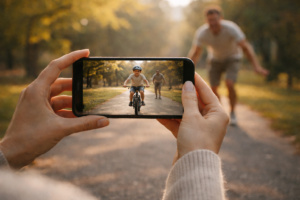
Why Parents Lose Milestone Details Even When They Care
This is not forgetfulness. It is how memory works under exhaustion and time.
Excitement Preserves Emotion, Not Precision
Emotional memory holds onto how something felt. It does not reliably store dates, ages, or sequence.
When a milestone happens, the brain prioritizes significance, not metadata.
Time Compresses Early Childhood
In hindsight, months blur together. Eight months, ten months, twelve months begin to feel interchangeable—even though developmentally, they are not.
Photos Create the Illusion of Recall
Parents assume the camera roll will fill in the gaps later.
Years later, scrolling through thousands of images does not answer the question you actually have.
Why Searching Photos Doesn’t Work
Photos capture evidence, not context.
Timestamps Rarely Reflect First Occurrence
The photo you find is rarely the first time something happened. It is the time a phone was nearby.
Volume Destroys Retrieval
Thousands of photos flatten memory. Instead of clarity, you get noise.
Images Don’t Answer the Real Question
Looking back, parents want to know when development happened—not just what it looked like.
Why the Details Matter Later
Parents return to milestones long after they happen.
During Pediatric Conversations
Doctors ask when skills emerged to understand progression, not to test memory.
With a Second Child
Parents instinctively compare timelines. Without records, everything feels “about the same,” even when it wasn’t.
When Children Ask About Themselves
Years later, children ask when they learned to walk, talk, or ride a bike. Clear answers come from records, not recollection.
How to Preserve Milestone Details Going Forward
The solution is not more photos. It is minimal structure.
Capture the Age Once
Recording the age at first occurrence is enough to preserve accuracy.
Keep Milestones Separate From the Camera Roll
Milestones deserve their own record, not burial inside thousands of images.
Use a System That Survives Time
Tools like Notion allow parents to record milestones quickly and retrieve them years later—without relying on memory or photo searches.
The Bottom Line
You remembered the moment because it mattered.
You lost the details because time and exhaustion reshaped memory.
A simple record preserves what memory cannot—so years later, you still know the answer.