
- Re-searching wastes time and loses the context you built the first time
- Critical numbers, manuals, and household knowledge constantly disappear
- Gifts become household items—one capture method handles both
- Knowledge compounds over time: capture once, find forever
You’ve already figured out how to change your car’s oil. You’ve researched every dinosaur your five-year-old asks about. You know which toy came from which grandparent. You’ve found the perfect slime recipe that actually works.
So why are you Googling it all again six months later?
The problem isn’t that you forget. The problem is that information moves through your life without sticking anywhere you can find it again.
The Real Cost of Starting From Zero
Every time you re-search something you’ve already found, you’re not just losing time. You’re losing the context you built the first time. The notes you made. The specific details that mattered for your situation.
At the mechanic: “What’s your VIN number?” You walk to the parking lot to squint at the dashboard.
Filling out insurance paperwork: “License plate number?” You pause. Was it ABC-1234 or the old car?
Your water heater leaks at 9 PM. You need the manual. It’s somewhere. In a drawer? A box? Did you even keep it?
Your smart lock resets after a battery change. The default code is in the manual. Which is inside the house. That you can’t enter.
These aren’t organization problems. They’re capture problems.
Why Paper Manuals Fail
You bought a water heater. It came with a manual. You put it somewhere safe.
Five years later when it breaks, you search the house for twenty minutes. Give up. Search online for the manual for another fifteen minutes. Find it. Can’t remember the purchase date for warranty purposes. Call the manufacturer. Wait on hold for thirty minutes. Find out the warranty expired last month.
Total time wasted: over an hour. Total frustration: maximum.
If you’d spent five minutes when you first bought it—model number, serial number, purchase date, photo of the installation sticker, PDF of the manual—you’d have everything you need five years later in five seconds.
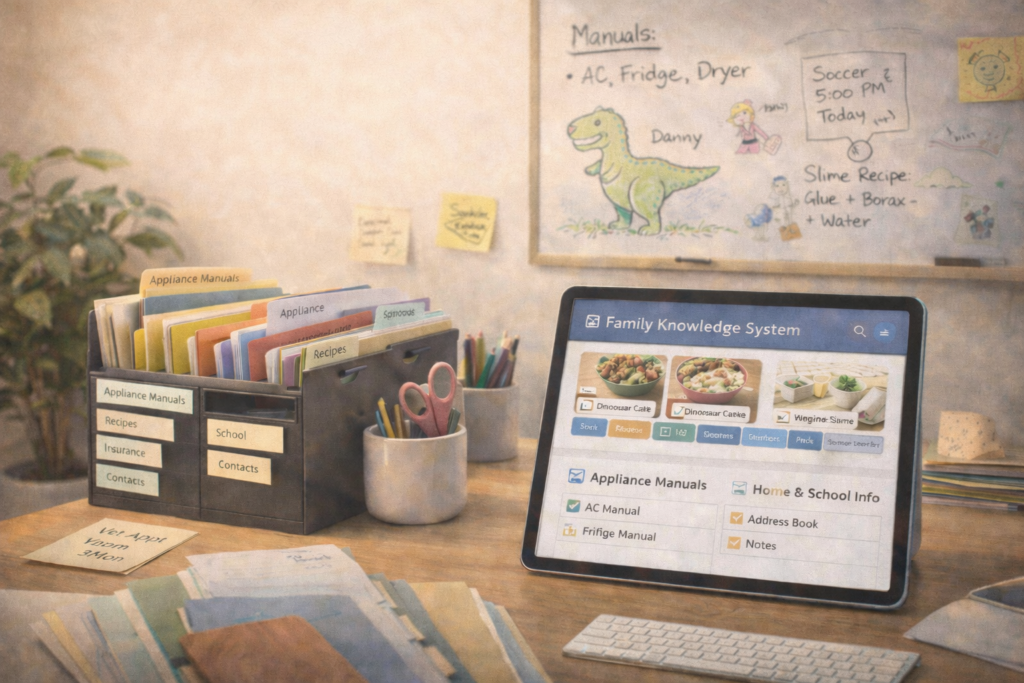
Information You Always Need But Never Have
Some information follows you around. You need it constantly, but it’s never quite accessible.
Critical numbers:
- Vehicle VIN and license plates (every service appointment, every form)
- Appliance model and serial numbers (when something breaks)
- Smart lock default codes (when batteries die)
- Utility account numbers (when you need to call)
Documents that disappear:
- Instruction manuals for water heaters, HVAC systems, appliances
- Warranty cards and purchase receipts
- Installation guides and troubleshooting flowcharts
- Product registration information
Things you re-Google:
- How to reset specific devices
- Default codes for particular lock models
- Troubleshooting for specific error codes
- Where hidden components are located
The pattern: You found it once. You’ll need it again. If you save it now, you’ll thank yourself later.
Beyond Household Items
The same capture problem shows up everywhere in family life.
Your four-year-old asks about T-Rex. You spend twenty minutes researching and explaining. Six months later with more questions, you start over.
You finally nail a slime recipe that’s not sticky. You use it once. Three years later with a younger sibling, you’re testing recipes again.
You find the perfect oil change video for your specific car model. You watch it every six months instead of just saving it with your own notes about the tricky parts.
Where Gifts Fit In
Three weeks after Christmas, you need to write thank you notes. Who gave what again? Wasn’t there a gift tag?
Six months later, you’re looking for the manual for that electronic game Grandma gave. It was in the box. The box is gone.
A gift starts as something from someone at an event. Then it becomes a household item with a manual and warranty information. Then it’s family history—”This was her favorite that year.”
Same object. Different contexts. One place to find it all.
The Gift-to-Item Connection
When your daughter opens a LEGO robotics kit at her birthday party, it’s a gift from Aunt Sarah in 2025. Two months later when pieces go missing, it’s an item with instructions you need.
The old way handles these as completely separate problems:
- Track gifts somehow (maybe a list, maybe memory)
- Write thank you notes
- Throw away packaging and lose the manual
- Later, search for the manual online when needed
The new way captures once:
- Item: LEGO Robotics Kit
- From: Aunt Sarah
- Event: Birthday 2025
- Manual: saved
- Photos: saved
Now you have a thank you list, gift history, manual access, and warranty information from one capture.
The Bulk Capture Method
Events create information faster than you can process it. Birthday parties with twelve gifts. Christmas morning chaos. Wedding presents from fifteen people.
Trying to track everything in the moment never works. The better approach: fast capture during the event, organized processing later.
Take photos as gifts are opened. Quick voice note: “LEGO from Aunt Sarah, art kit from Grandma, puzzle from the Johnsons.” Store everything together labeled by event.
Thirty minutes later when things calm down, create the actual records with manuals and details. One capture session creates thank you lists, gift history, warranty tracking, and permanent manual access.
Building Systems That Remember
The shift happens when you stop trying to remember everything and start building a system that remembers for you.
When you buy the water heater, spend five minutes: model number, serial number, purchase date, photo, manual PDF. When it breaks five years later, everything is there.
When your kid asks about dinosaurs, spend an extra two minutes saving what you found. Next time, you have it in five seconds. By kid number two, you have a collection.
When you figure out car maintenance, save the video and add your notes about the tricky parts. Every oil change becomes easier.
The Compounding Effect
This isn’t about being perfectly organized. It’s about building knowledge that gets more valuable over time.
Year one: You’re still building, some re-searching happens.
Year two: You’re finding your own saved information more than Google.
Year five: You have years of solutions, warranties, and family history.
Year ten: You’re the person everyone asks because you “remember everything.”
You don’t. Your system does.
Start With What’s Next
You don’t need to capture your entire life at once. Start with what’s coming.
Next time something breaks, save the model number and manual before you fix it.
Next birthday or holiday, try bulk photo capture and process it later.
Next time you solve a recurring problem, save the solution.
Next time your kid asks a question you had to research, save what you found.
Each capture builds on the last. The effort compounds instead of repeating.
What This Actually Means
Every Google search is starting from zero. Every capture builds on what you already know.
The VIN number you need at the mechanic. The smart lock manual you can’t find. The water heater warranty information. Your daughter’s birthday gifts. The slime recipe that worked. The dinosaur facts your son keeps asking about.
They’re all the same problem: information you found once that you need again.
They’re all the same solution: capture it, process it, find it forever.
The question isn’t whether you need a family knowledge system. You’re already building one—it’s just living in scattered browser history, forgotten bookmarks, and “I know I saved that somewhere” piles.
The question is: do you want to actually be able to find it again?